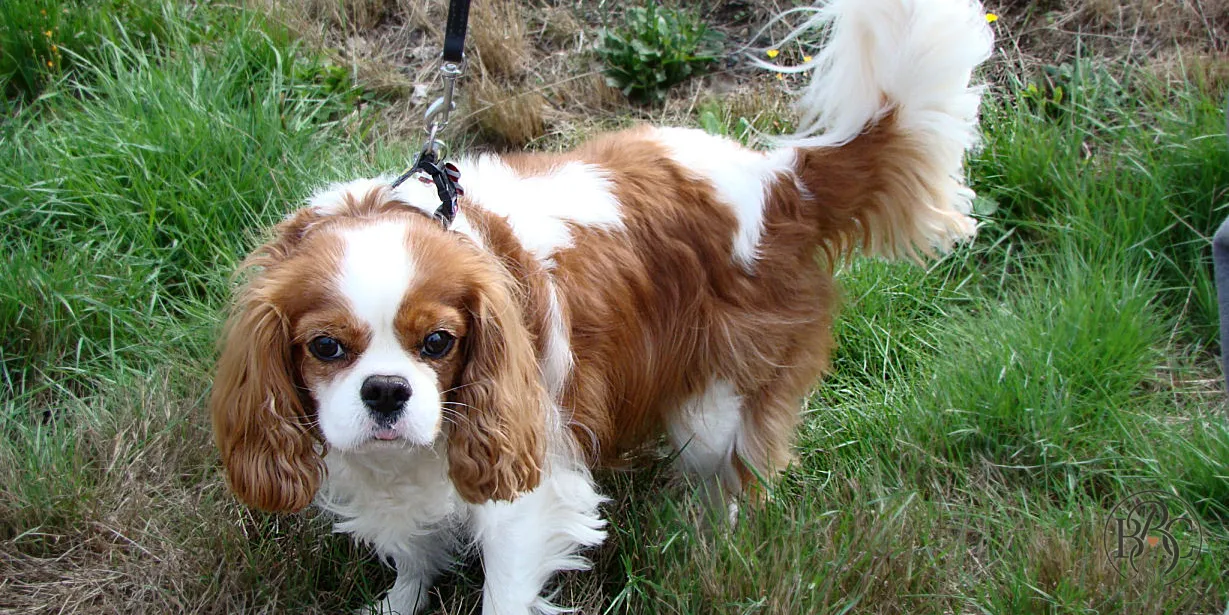
Meet the Cavalier King Charles Spaniel
A gentle, affectionate companion that has charmed laps for centuries — and a breed that rewards careful, health-focused breeding. Here's what to know before you welcome one home.
A toy spaniel with a sporting heart
Sweet-natured, adaptable, and endlessly affectionate
Cavaliers are the quintessential companion dog: bred for centuries to be at our side, they are happiest in your lap and unhappiest left alone for long stretches. They greet strangers, children, and other dogs as friends, which makes them wonderful family pets but poor guard dogs.
Beneath the silky coat is a true spaniel — curious, playful, and game for a walk, a hike, or a game of fetch — yet just as content to nap on the sofa. They are bright and eager to please, which makes gentle, reward-based training easy. They thrive on companionship and do best in homes where someone is around much of the day.
Life expectancy
A well-bred, well-cared-for Cavalier generally lives 12 to 15 years. Lifespan is strongly influenced by the heart and neurological health of the lines a puppy comes from — which is exactly why responsible breeding (below) matters so much. Good weight management, dental care, and regular veterinary checkups all help your Cavalier live a long, comfortable life.
Common health issues in the breed
Like all purebred dogs, Cavaliers carry breed-specific health risks. A responsible breeder doesn't hide them — they screen for them. Here are the conditions that matter most, and how we test to reduce the risk before ever breeding a dog.
Mitral Valve Disease (MVD)
A degenerative heart-valve condition and the breed's most significant health concern; it can cause a murmur and, over time, heart failure.
How we screen: Annual cardiologist exams, following the breed club's MVD protocol — breeding only older dogs with clear hearts whose parents' hearts also stayed clear.
Syringomyelia & Chiari-like Malformation (SM/CM)
A neurological condition where a skull-and-spine mismatch causes fluid-filled cavities in the spinal cord, which can cause pain or scratching.
How we screen: MRI screening of breeding dogs and breeding to MRI-graded results to lower the risk.
Eye conditions
Hereditary cataracts and retinal problems can occur in the breed.
How we screen: Annual exams by a veterinary ophthalmologist (OFA/CAER).
Patellar luxation
A kneecap that slips out of place, sometimes causing a little skip in the step.
How we screen: OFA patella evaluation of every breeding dog.
Hip dysplasia
A malformed hip joint that can lead to arthritis later in life.
How we screen: OFA or PennHIP hip evaluation before breeding.
DNA-tested conditions
Episodic Falling Syndrome and Curly Coat / Dry Eye are inherited conditions with reliable DNA tests.
How we screen: DNA testing so two carriers are never paired.
No breeder can guarantee a dog will never get sick — but breeding only from tested, cleared parents dramatically lowers the odds and pushes the onset of heart disease later in life. You can see every one of our parents' clearances on their profile pages.
Why a Cavalier from a reputable breeder costs more — and why that matters
A health-tested Cavalier puppy costs more than one from a classified ad or a pet store. That price isn't markup — it's everything a responsible breeder does to give you a healthy puppy and a dog that stays healthy. Here's where it goes, and why it protects you.
Cardiology, MRI, eye, patella, hip and DNA testing — often $1,000–2,500 per dog, repeated every year.
Following the MVD heart protocol means breeding older dogs and fewer litters — more cost per puppy, far healthier lines.
Prenatal care for the dam, whelping, exams, vaccinations, deworming and microchipping for every puppy.
Puppies raised underfoot with early neurological stimulation, household sounds, handling and gentle exposure.
A written health guarantee, a contract, and a breeder you can call for the life of your dog.
We take any dog of our breeding back, at any time, so none ever ends up in a shelter.
What you're really choosing between
- Both parents cardiac-, eye-, patella-, and MRI-screened before breeding
- Follows the breed club's MVD breeding protocol (breeding later, from older clear hearts)
- Puppies raised underfoot, vet-checked, vaccinated, microchipped, and socialized
- A written health guarantee and a contract
- Takes the dog back, for any reason, for its whole life
- Answers your questions for the next 15 years
- No health testing — parents' hearts and brains were never screened
- Bred young and often, to produce as many litters as possible
- Little early socialization; higher risk of fear and health problems
- No guarantee, no contract, no support after the sale
- Higher rates of early heart disease (MVD) and syringomyelia (SM)
- Often costs far more in the end — in vet bills and in heartbreak
You're not paying for a puppy — you're investing in years of health, a known lineage, and a breeder who stands behind their dogs for life. A "cheap" Cavalier with an untested heart can cost thousands in cardiology and neurology bills, and years cut short. The most expensive puppy is almost always the one that wasn't health-tested.
From royal lapdogs to a modern breed — and why genetics matter
Toy spaniels have curled up in royal laps for centuries. They were so beloved by King Charles II of England — who was said to be rarely seen without a few at his heels — that the breed carries his name to this day.
By the early 1900s, fashion had reshaped the little spaniel toward a flatter, shorter face. Then in 1926 an American, Roswell Eldridge, offered prize money at England's Crufts dog show for spaniels of the old type, with the longer muzzle seen in old paintings. Breeders answered, the original look was revived, and the dogs were recognised as a distinct breed — the Cavalier King Charles Spaniel — by the UK Kennel Club in 1945 and the American Kennel Club in 1995.
But that revival was built from a very small number of founding dogs. Nearly every Cavalier alive today traces back to roughly six dogs from the 1920s. This “founder effect,” made worse by the popular-sire effect — where a handful of champion studs are bred very widely — left the breed with limited genetic diversity and concentrated the very conditions we now screen for, especially mitral valve disease (MVD) and syringomyelia (SM). A narrow gene pool means a higher chance that both parents quietly carry the same inherited risks.
That is exactly why thoughtful breeding isn't optional in this breed — it's everything. Conscientious breeders health-test every parent, follow the heart-breeding protocol, avoid overusing popular sires, track estimated breeding values, and work to preserve and widen diversity. Choosing one of those breeders is how you bring home a healthier puppy — and how the breed itself gets healthier with each generation.
See the difference for yourself
Every one of our breeding dogs has its health clearances published for you to read — heart, eyes, patellas, hips, and MRI.